Outcomes first
18% → 47%
Reimbursement success rate
17% → 9%
Support calls about reimbursements by September 2022
12%
Immediate drop in reimbursement-related Support calls at launch
Both metrics continued improving after launch. Beyond the numbers, the feature replaced a trust-eroding back-and-forth with a structured, trackable process that served Owners, Renters, and HyreCar operations equally.
Overview
Vehicle Owners had communicated through several channels: Account Managers, Support requests, and surveys, that they were experiencing poor rates of success when requesting reimbursement fees from Renters. Before this feature, those requests accounted for 17% of all incoming HyreCar Support calls.
Without a dedicated feature, the entire process ran through direct messaging between Renters and Owners. These interactions occasionally went sour, producing bad experiences on both sides and a growing culture of mistrust in the marketplace.
Problem statement
The absence of a structured reimbursement feature was having a significant negative effect on both the Owner's and HyreCar's operational costs. We hypothesized a solution that would address the following:
- Enable Owners to submit reimbursement requests directly to Renters within the HyreCar app.
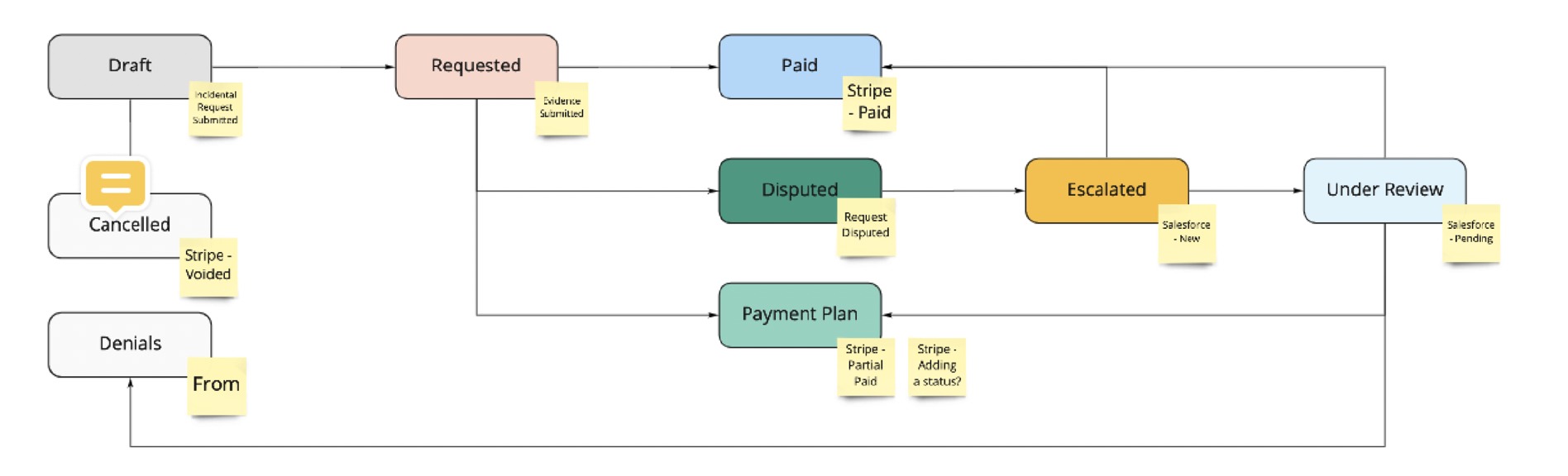
- Provide tools to manage each case through its full lifecycle.
- Allow HyreCar to more easily track requests and maintain analytics.
- Extend the submission window with a Draft/Save capability.
- Ensure Renters received timely notifications with clear calls to action.
Process
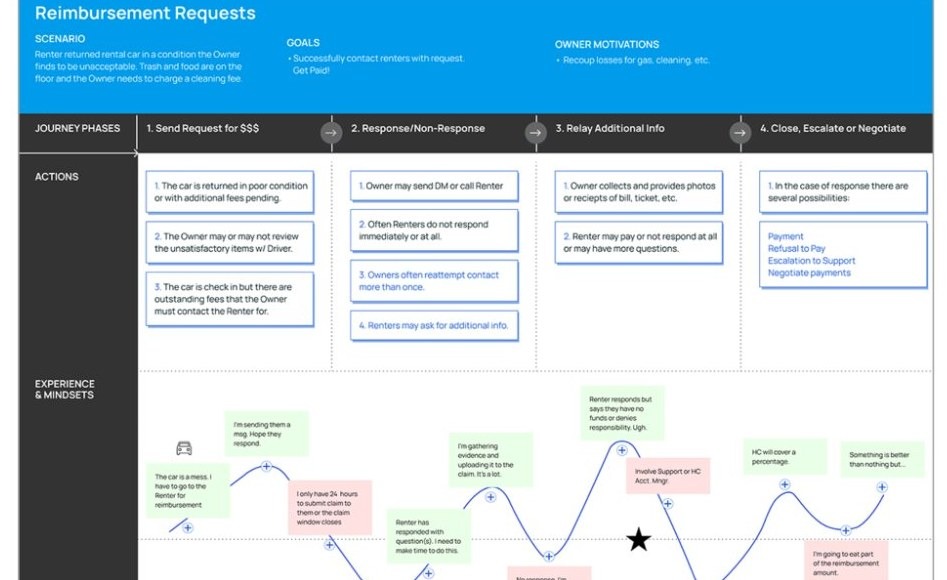
Supported by internal subject-matter experts, a Product Owner and Owner Representatives, we surveyed and interviewed both person-to-person (P2P) Owners and Fleet Managers. Early research focused on understanding the current workflow: where requests stalled, where evidence got lost, and where statuses went dark.
The discovery phase included documentation of the current workflow, identification of the many pain points encountered in receiving payment, and specific challenges in managing requests and tracking statuses. We quickly mapped our core workflow against a useful precedent: the existing insurance claim submission experience. The two flows were conceptually similar enough to share structure, but required a deliberate pass on terminology and visual presentation so users could never confuse a reimbursement request with an insurance claim.
Interviews with P2P Owners and a key Fleet Manager contact assisted directly in developing this feature. With problem statements complete, we developed hypotheses about how to collect the reimbursement information, manage requests through the lifecycle, and ensure all parties received timely notifications.
Discovery and key insights
Once a happy path was agreed on, we demonstrated the workflow to our Fleet Manager contact and a handful of P2P Owners. The pivotal finding: the 24-hour submission window was the most significant pain point. Owners didn't just struggle to track request statuses. They physically couldn't gather the required photo evidence within the time available.
The 24-hour window was a business rule we couldn't change. But we could design around it: adding a Draft state would give Owners up to an additional 36 hours of grace to complete and submit a saved request. This introduced new complexity: each request type could have its own unique timelines, and displaying statuses so that drafts could be easily resumed was a formidable new design challenge.
The solution we arrived at was primarily a dashboard-type view tracking the status of each request. Some compromise was necessary: Fleet Managers needed a scalable view across many vehicles, while most P2P Owners only needed to track a single car. The dashboard model served both without forking the experience.
An unexpected outcome post-launch: the Draft function was not utilized as much as anticipated in the first 60 days. Surveying fleet managers and representatives revealed that users simply weren't aware of what the feature offered. A draft didn't fit with their mental model as something that would give them extra time to gather evidence; they thought of it as a way to save comments and return later. Improving the messaging around drafts became a follow-on priority.
Design solution
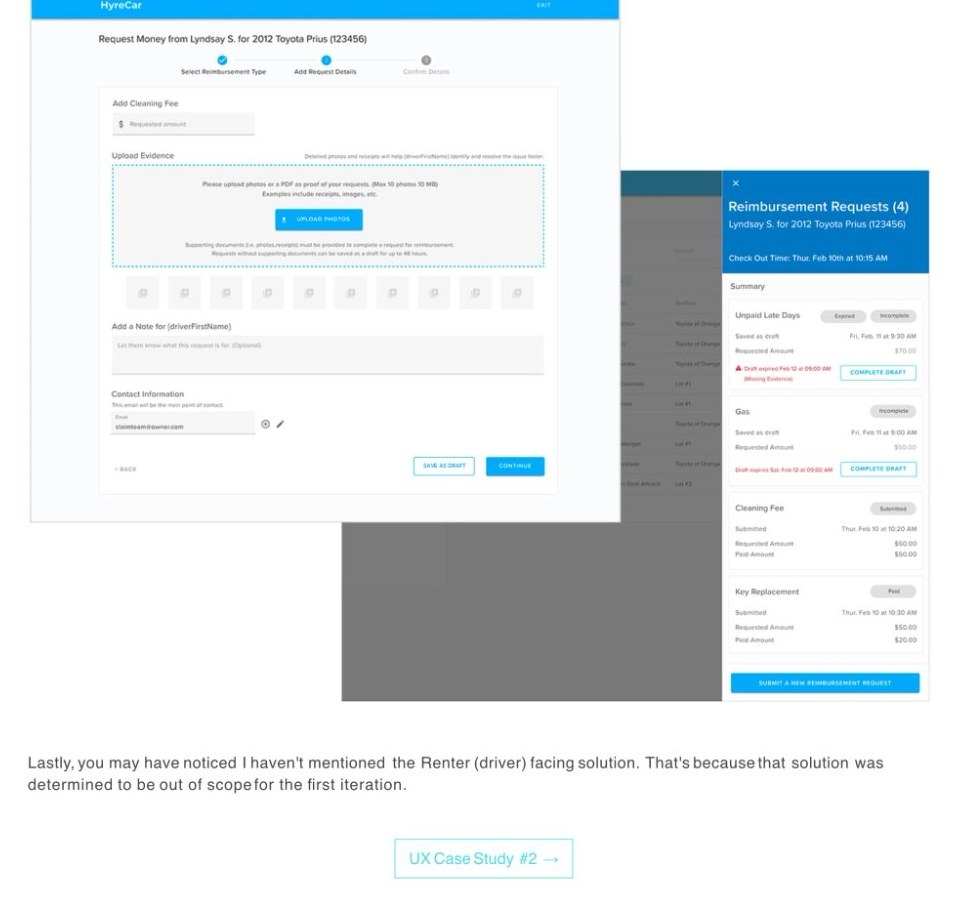
The final design centers on a funnel entry page from HyreCar's existing design system, allowing Owners to select a reimbursement type and progress through evidence upload and confirmation. The request detail panel, accessible from the rental table, surfaces all active request statuses inline, eliminating the need for a separate status screen and solving the cognitive load problem that had plagued earlier iterations.
The Renter-facing solution was determined to be out of scope for the first iteration and was not included in this release.
Outcome
RESULT
Within months of launch, reimbursement success climbed from 18% to 47%, and reimbursement-related Support calls fell from 17% of all incoming volume to 9% by September 2022, a durable reduction in operational cost and a measurable repair to marketplace trust between Owners and Renters.